Saturday, April 16, 2011
Some interesting things about living in our country
If you're like me, (and as what follows is about paying taxes I sort of hope that you aren't like me. I paid my taxes once as a functioning adult before my wife took them over the following year and every year since, filing them via TurboTax or whatever, while I've no earthly clue how one goes about properly paying taxes or what our income is or any of that sort of stuff) you really enjoy that old saying about certainties and "death and taxes" because it is funny and true.
But if you're also like me it's funny to think about where all of your taxes actually go. I assumed that the majority of my taxes went to funding NPR's leftist/communist agendas, funding the EPA's continuing interference in the business of God-fearing Americans with trumped up ideas about climate change, and maybe a small bit was left over for things like Social Security and Medicare (why oh why can't we figure out health care. The people who have it are already financing it for others. Ugghhhh). Anyhow, a friend of mine put up this handy dandy tax calculator that helps you to understand where all of your tax dollars are actually going. Hint: It's not all being devoted to the stipends of guest on Wait Wait Don't Tell Me and cleaning up the Chesapeake Bay watershed. This is the sort of thing that you should immediately check out so as to educate yourself about your tax dollars (insert joke about the federal government and something along the lines of your tax dollars sort of trying to work amidst reams of red tape if you're so inclined).
http://www.whitehouse.gov/tax-receipt
No really, do it. Go back up to that previous link and at least do the shortcut where they let you roughly estimate your income. Or hell, just estimate someone else's income to see where their tax dollars went. Just look at your taxes. Who knew taxes could be this fun?
And look, if you still haven't done it you're a lot like me. 1) You don't like being told what to do. 2) You are too busy, though not too busy to be reading this blog. 3) Lazy in the sort of way that so much of the American populous is now. We've sort of ceded a lot of our civic duties to the government, and now we're pissed that they're running over budget. And this sort of laziness, of which this author is most certainly guilty, is probably going to become problematic at some point in the future or perhaps we'll just go bumbling along. "This country has a lot of big problems. Congress is one of them."
Fact:
Article below that talks about how NPR and the EPA are ruining the world by taking up all of our taxes. Hint: This turns out to be untrue. Also, read on particularly if you were too lazy to use the link to see where your hard earned dollars went. If your dollars were earned easily don't worry about it.
Relevant Portion from Rasumessen Reports. Bolded sections mine.
The latest Rasmussen Reports national telephone survey shows that 27% of Likely Voters say the United States does not spend enough money on the military and national security. Thirty-two percent (32%) say America spends too much on defense, while a plurality (37%) thinks the nation spends about the right amount. (To see survey question wording, click here.)
But only 25% of voters believe the United States should always spend at least three times as much on defense as any other nation. Forty percent (40%) do not think the country needs to spend this much, while 35% are not sure. Interestingly, if the government were to actually spend only three times as much as any other nation, it would imply a significant cut in U.S. defense spending.
For fiscal year 2011, the total budget for defense is estimated to be around $719 billion. That does not include the cost of veterans’ care, which totals another $124 billion. By comparison, no other nation in the world spends more than $110 billion on defense. Earlier polling showed that just 58% recognize that the United States spends more on defense than any other nation in the world.
Underlying voters’ opinions on how much the United States spends on defense is the fact that many don’t know where most of the government’s money already goes. Just 40% can correctly identify that most federal spending goes towards national defense, Social Security and Medicare. Roughly the same number (38%) believes this statement to be false, while another 22% are not sure.
So yeah, we might have some bigger fish to fry in this whole budget debate then public radio and the clean air act and food stamps.
A modest proposal related by this same friend and an NPR commentator related to decreasing our budget deficit. The other option is to tax more, which it seems that no one likes, so even though the idea listed below is a form of taxation, it doesn't have the dirty word association like taxes do and gives the added benefit of relieving the debt burden on the middle class type folks who have large things like student debt hanging over their heads.
Inflation - the reduction in the nominal value of currency - reduces the real value of debts. While lenders take inflation into account when they decide the terms of a loan, unexpected increases in the rate of inflation cause categorical debt relief.
And yes, this does mean we wouldn't be able to purchase as many things and it would slow economic growth, but perhaps it's good to ask ourselves whether we want a swiftly growing economy ad infinitum and whether things go about making us any happier...Okay enough on budgets. Note: The historical antecedent that would argue against this is the fall of Rome, which some speculate was brought about by hyperinflation and an increased tax burden its citizenry due to regular infrastructure needs on a constantly expanding empire, (I think we're done expanding though Canada is tempting) and an increased amount on defense spending. (Please no more wars in the middle east) Note to Note: The real downfall though if we're going the tax route was their eventual inability to collect much revenue at all. But this has all gotten a bit long and even reasonable people who have checked on their tax returns cannot be expected to read about the tax problems for palatines in the 440's without eventually glazing over.
Thursday, April 14, 2011
About Sadie
Due to a request from one of my three readers, on a good day, I'm going to take a brief respite from my never ending quest to have David Wallace read by every man woman and child in American to talk about Sadie.
Listen, I haven't written about the little bundle of joy... Note: We don't always bundle here now, so sometimes she's just a many chinned round mound of joy. because the biggest secret that nobody tells you about raising kids is that it's easy. I mean, sure it takes up almost all of your time/energy on a daily basis, but it doesn't take more than that. What I mean to say is that, for the most part, barring the occasional fit, which I generally understand the origins of anyway, it's a pretty rewarding gig.
Not only are you spending time with probably the cutest human being on the face of the earth. And yes, I'm well aware that every parent thinks that about their own offspring, and that's probably a good thing anyhow because it would be weird to look at your child and think, "Huh, we could have done better than that couldn't we have hon?" Also, this extremely cute person, see above, has your blood coursing through their veins, which means you're genetically predetermined to be extremely interested in just about everything they do. The way that they interact with the world is a direct reflection on you, yes as a parent, but also just from a generic science stand point. As in, heh, my offspring should be smarter than to put a share knife in their mouth because that's certainly something I wouldn't do. I mean, the person that people find most interesting in the world is generally staring at them in the mirror each morning, and you're getting the next best thing only cuter and younger and therefore more full of potential, succeed or fail.
I'm probably making parenting sound a bit more selfish than it is. I'm just trying to get at that feeling that you get when you stare at your child and just feel so much intense love of the sort that generally comes from early romantic attachments, except, just a guess, I think the honeymoon period on this one is longer. I probably have a lot more to say about how to properly raise a child, or at the very least a girl who is roughly Sadie's age, though boy girl distinctions prove to be more important starting around age 1.
Anyhow, my advice, which I've related to S a number of times has to do with allowing a baby to queue you for nap time rather than you trying to force it on them. I'd say more, but I'm planning to write about putting your baby to bed properly and all the queues you should follow. I'm fairly certain that I can get at least 230 pages out of the idea as long as I'm free with diagrams and bullet points and the like. Anyone who has read Malcom Gladwell or virtually any book of non-fiction about an Idea, emphasis intended, can relate to the seeming interminable nature of the text after the first 125 pages or so when the point has been proven and the writing goes on and on illustrating that point again. This to me would be like laughing at every cat video on YouTube, I mean, at some point their just a bunch of f-ing animals, go give a homeless person a buck and stop wasting my time.
You have to admit the cat is pretty cute.
On an unrelated note in my never ending quest based on the movie The Never Ending story. Note: For years, literally until I watched it again in college, I thought the princess at the end of the movie was bald, and it turned out she just had her hair pulled tightly back. I think the point I'm trying to make here is that she probably should have been bald. The movie would definitely have been made more strangely creepy for children if that had been the case.
From Farther Away by Jonathan Franzen, a New Yorker essay oddly aimed at demythologizing the apparent hagiography of David Wallace that Franzen feels has been going on. Though his points seem well taken in some instances, he's also widely regarded as kind of jerk in the literary world.
From Father Away
David and I had a friendship of compare and contrast and (in a brotherly way) compete. A few years before he died, he signed my hardcover copies of his two most recent books. On the title page of one of them, I found the traced outline of his hand; on the title page of the other was an outline of an erection so huge that it ran off the page, annotated with a little arrow and the remark “scale 100%.” I once heard him enthusiastically describe, in the presence of a girl he was dating, someone else’s girlfriend as his “paragon of womanhood.” David’s girl did a wonderfully slow double take and said, “What?” Whereupon David, whose vocabulary was as large as anybody’s in the Western Hemisphere, took a deep breath and, letting it out, said, “I’m suddenly realizing that I’ve never actually known what the word ‘paragon’ means.”
Wednesday, April 13, 2011
The Pale King: Reviewing the Reviews
From the Globe and Mail review by Matt Kavanagh
Introductory Note:
In the early 1980s, American writer David Foster Wallace suffered a nervous breakdown while away at college and retreated to his parents’ home to recover. He drove a school bus for a while. He was diagnosed with depression and started taking medication. Eventually, he returned to Amherst, where he took courses in creative writing. He went on to pen Infinite Jest, one of the most critically lauded novels of the last novels of the last quarter-century. His short stories garnered wide acclaim; several pieces of his long-form journalism are rightfully celebrated as classics of the genre. He was awarded a MacArthur Fellowship, the “genius” grant. In 2008, after discovering that his antidepressant no longer kept the symptoms of his illness at bay, he killed himself.
Relevant Portion:
Like its predecessor, The Pale King is an electric novel of ideas. Wallace uses the tax system as a means to explore our obligations to one another, what it means to be bored and the problem of information, which is to say, what happens when there’s too much of it, overwhelming our ability to make meaningful choices.
My take: The review begins by trying to elaborate the plot of TPK. Thus, we spend about four paragraphs with the author sort of gallantly floundering to elucidate just what the hell was happening in TPK. The big reveal comes in the last ten pages of TPK though. Michael Pietsch, Wallace's editor, chose to include ten pages worth of notes on possibilities for where the plot might lead. And, if you are familiar with Wallace's work you'll know that ten pages worth of notes is probably 300 pages or so of actual text. Thus, the project that the early portion of the review sets, explaining the plot, is misguided. This book, even more so than Infinite Jest, is about characters, voice, ideas, polyphony in the grand tradition of Faulkner. The plot hangs together loosely at best, and it's probably unfair to expect it to do anything else. The work was unfinished.
From Boston.com
Relevant portion:
Wallace’s genius was that he could absorb the infernal logic of data — all those vectors of complexity, its relentless torrent — and still give us the magic of narrative. That moment when we, as readers, become co-imaginers of a text because there are characters in whom we believe, and a story we learn how to anticipate. Information and storytelling: They are opposing forces, like certainty and faith, yet Wallace stood across this divide and proved that if there was, in fact, a social novel of our time, here is where it would be built. Not by papering over the ruptures in realism, but by writing right through them.
My take: Uh, yes. I think the thing that I'm saddest about is losing the enormity of Wallace's talent and ambition. I haven't read any other contemporary authors who are as interested in attempting to synthesize everything that it means to be happy and hail in these data tinged days. The largest manifestation of this in Wallace's work comes when characters spend time doing things like thinking about thinking or in TPK, the awkwardness of flying on a plane, all the little details that make it a strange type of hell. And I'll miss his ability to catalog all of those things that generally pass by us because we are so rarely truly aware. I suppose the last bits seem unrelated, however, they are central to TPK. Ie, when we have five thousand things to pay attention to, what do we choose?
From the Kansas City Star's review by Kevin Canfield:
Relevant portion, which Canfield actually pulled directly from TPK.
“I learned, in my time with the Service, something about dullness, information, and irrelevant complexity,” explains David Wallace, a fictionalized version of the author and the book’s occasional narrator. “About negotiating boredom as one would a terrain, its levels and forests and endless wastes. … And now ever since that time have noticed, at work and in recreation and time with friends and even the intimacies of family life, that living people do not speak much of the dull.”
In what is as close as he comes to a direct explanation of his decision to write about boredom, Wallace notes the lengths to which many of us go to avoid it: “Walkmen, iPods, BlackBerries, cell phones that attach to your head. This terror of silence with nothing diverting to do. I can’t think anyone really believes that today’s so-called ‘information society’ is just about information. Everybody knows it’s about something else, way down.”
My take: Yup.
Thought Catalog's Phil Roland
Although, to be pedantic, I suppose no one will be finishing it. David Foster Wallace’s posthumous novel is incomplete, after all. Which isn’t to say that you shouldn’t bother to read it. You most certainly should. Just be aware that it’s not the kind of book designed to be a blockbuster, to keep you turning pages late into the night. Which you’ll be doing a lot of, if you’re a fan of literature. But it won’t be because the plot is so engaging (it is indescribably tedious at times) but because DFW was so damned good at writing that you can’t really believe what you’re reading. If it renders you speechless it won’t be because the prose has taken your breath away, but because you suddenly feel unworthy to be speaking the same language as someone who has so obviously and completely mastered the art of bending it to his will. And if it makes you sad, it will have less to do with the book itself and more to do with the fact that The Pale King is the last you’re ever going to get from the greatest American writer of this generation. That’s it. That’s all. Show is over, folks. You don’t have to go home, but you can’t stay here.
I never even heard of David Foster Wallace until a few days after his suicide in 2008. And I likely wouldn’t have heard of him until long after were it not for my desire to impress the cute, bookish librarian and the honest realization that Salvatore’s Icewind Dale trilogy wasn’t going to quite cut it. So I chose the weightiest, smartest-looking tome I could find, which turned out to be Infinite Jest. (Atlas Shruggedwas on the short list; I declined on the grounds that I was having a good day and didn’t feel like hating everyone.)
“For the kids,” I lied, seeing the smirk on my cute, bookish librarian’s face as she scanned my selection of fantasy novels.
“It’s so sad,” she said when she came upon Infinite Jest.
“I know, right?” I had no idea what she was talking about. I thought she meant the book.
“I still can’t believe he could just kill himself like that.”
Oh. Oh.
Cont:
It’s a fractured, potholed mess of intentionally dull descriptions of white collar government work and “Realism, monotony. Plot a series of setups for stuff happening, but nothing actually happens.” While most of this can be ascribed to the book’s unfinished nature,
Like the last few cigarettes in the pack before another attempt to quit, I’m making the The Pale King last. And then I plan to give up when I get close to the end. Because right now I can’t conceive of living in a world where I’ve read the entire oeuvre of one of the greatest literary minds to ever exist–a human iceberg whose depths will never be fully charted–knowing that there will never be any more. Rather nonsensical, true, but I will at least have ensured myself that there is some measure of beauty and mystery left unexplored in my world at least, and I can tease myself with those final, unread pages for years to come, each time thinking the exact same thing I was thinking when I first found myself lost in his work:
God I wish he hadn’t killed himself.
My take: Extra points for being a more personal review. I'm not going to touch the NYT review by
Michito Kakutani because her reviews are all over the map. She called Franzen's Freedom, a good but decidedly not great or excellent novel, a masterpiece. She also reviewed Infinite Jest and called it essentially a work authorial selfishness. When reviewers miscast, or seem to misunderstand books I don't generally give them much credence even if they review for The Times.
On Endings by Robert Douglas from The Telegraph
Wallace seems to have recognised as much all along. His first novel, The Broom of the System, ended mid-sentence, with fictional editor Rick Vigorous explaining that “You can trust me… I’m a man of my ”. Automatically we find ourselves filling in the missing “word”, which is both a joke about publishers always having the last word and a reminder that we have been Wallace’s collaborators from the start. His short story “Good Old Neon” ends twice, once with the phrase “Not another word”, and again two pages earlier with a footnote that concludes “THE END”.
It is, then, a wonderful example of editorial tact that the fragment chosen to end The Pale King has “you” as its final word: “She’s right there, speaking calmly, and so are you.” Because that’s what Wallace’s writing came down to: not him, but “you”, the reader.
Everything he wrote was unfinished, because it was offered as one side of a bargain: he would extend his readers’ sense of the possible, and all he asked was that they populate his fictional world to make it feel less lonely. It made everything he wrote into a work in progress. But then, as a character in one of Tennessee Williams’s plays points out: “Humanity is just a work in progress.”
And so on....
Friday, April 1, 2011
Some writing
Elegy for a Silk Tree
After his mother’s funeral was over and the few mourners had left, faces he couldn’t quite place in the fog, he sat on the cold stones and reminisced about the summer when he began to doubt the existence of things.
His childhood, to that point, had been about credulity. The back yard was the clay upon which he pressed his bits of belief. The yard was framed twice over, first by a graying cedar fence and then by junipers, winters gem, and English Holly. The rectangular center of the yard was made up of ambiguous brown grass cut through with clover and dandelion, which was occasionally cropped by the neighbor’s cadre of rabbits. The right side of the yard was dominated by a large white pine, branches lopped off so that the first available foot hold was well beyond his reach that rose spire like into the bright blue cathedral of the sky. That lack of a foothold, so precious to a child, led him away from the awesome pine and towards the old silk tree in the side yard. The tree was positioned just behind the gate on a small strip of land that was shaded almost year round by the junipers and winter gem. It stood about eight feet tall, sturdy and many limbed, its grey bark riddled by holes from some long dead woodpecker. The umbrella shaped canopy would carry pale pink blossoms come spring. He loved the tree with the sort of intensity that other children reserved for their dogs. He didn’t care for dogs.
He remembered spending evenings, the sky a purple bruise, a warm wind blowing from the west through the small valley town raising goose bumps on his bare arms, climbing into the welcoming arms of the silk tree, placing his foot at an intersection between two limbs that looked like nothing so much as an elbow. And he’d sit, for what seemed like days, with his spine pressed, not uncomfortably, against the tree’s reassuring trunk, his feet dangling in space, while mosquitoes and robins engaged in a deathly evening ballet. Beneath him bits of the foundation lay exposed, exhumed for a canal he’d built for his army men a summer ago. He’d used the larger rocks—dolostone, limestone, and brown chert—as mountains for the soldiers to climb over as they trudged wearily onward. In the distance other small birds, nuthatches and house sparrows, kept the evening full of song. They were average singers at best.
After his mother’s funeral was over and the few mourners had left, faces he couldn’t quite place in the fog, he sat on the cold stones and reminisced about the summer when he began to doubt the existence of things.
His childhood, to that point, had been about credulity. The back yard was the clay upon which he pressed his bits of belief. The yard was framed twice over, first by a graying cedar fence and then by junipers, winters gem, and English Holly. The rectangular center of the yard was made up of ambiguous brown grass cut through with clover and dandelion, which was occasionally cropped by the neighbor’s cadre of rabbits. The right side of the yard was dominated by a large white pine, branches lopped off so that the first available foot hold was well beyond his reach that rose spire like into the bright blue cathedral of the sky. That lack of a foothold, so precious to a child, led him away from the awesome pine and towards the old silk tree in the side yard. The tree was positioned just behind the gate on a small strip of land that was shaded almost year round by the junipers and winter gem. It stood about eight feet tall, sturdy and many limbed, its grey bark riddled by holes from some long dead woodpecker. The umbrella shaped canopy would carry pale pink blossoms come spring. He loved the tree with the sort of intensity that other children reserved for their dogs. He didn’t care for dogs.
He remembered spending evenings, the sky a purple bruise, a warm wind blowing from the west through the small valley town raising goose bumps on his bare arms, climbing into the welcoming arms of the silk tree, placing his foot at an intersection between two limbs that looked like nothing so much as an elbow. And he’d sit, for what seemed like days, with his spine pressed, not uncomfortably, against the tree’s reassuring trunk, his feet dangling in space, while mosquitoes and robins engaged in a deathly evening ballet. Beneath him bits of the foundation lay exposed, exhumed for a canal he’d built for his army men a summer ago. He’d used the larger rocks—dolostone, limestone, and brown chert—as mountains for the soldiers to climb over as they trudged wearily onward. In the distance other small birds, nuthatches and house sparrows, kept the evening full of song. They were average singers at best.
Monday, March 28, 2011
Etymology: beating a dead horse
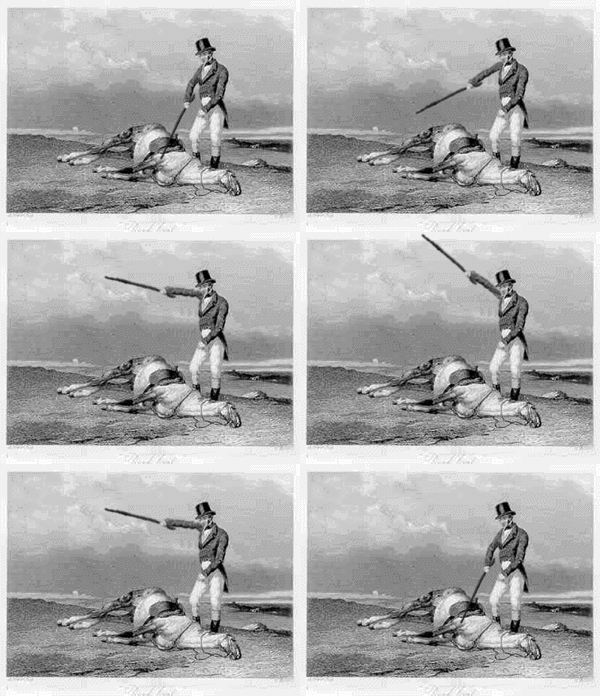
I spend a bit of time on a website entirely devoted to Michigan football, which is awesome. It provides me hours of distraction and relief. However, the main thing that it provides for me is funny picture. Anyhow, sports websites and more specifically arguments are pretty much carried on with as much civility as debates on whether we should be a giant socialist country or not are in Congress. Anyhow, at some point during the discussion on Mgoblog somebody tends to bust out this picture of a guy beating a dead horse vociferously. Or, vociferously beating a dead horse. Pick your poison. Either way, it's amazing.
But we should probably get down to tackling the word root origin instead of just chuckling over this jaunty fellow wailing away on what might actually be a camel. Wikipedia describes the idiom, a bit toolishly as flogging a dead horse and claims that it is sometimes used in the bits of the Anglophone, you just know some Brit wrote this, world. Wrong, Wikipedia. Everyone says beating a dead horse, even Brits, and if they don't like it they can talk to George Washington.Oh, snap. Below is a graph of how I used the term correctly.
Brief aside to admire cute babies laughing.
Okay, enough enacting the labyrinth of the post-modern mind. The OED credits it to the globe in 1972, while Wikipedia, who do you trust?, credits it to famed orator, a term I use infrequently, John Bright. Apparently he used it in reference to Parliament feeling apathetic about more democratic representation. An idea I can get similarly apathetic about because enlightened despotism is the way to go.
Wikipedia also offers this little nugget, which gives me a second chance to plug Antigone on this very blog when the great orator Tiresias says, "Nay, allow the claim of the dead; stab not the fallen; what prowess is it to slay the slain anew."
Things I've learned about parenting.
She seems to sleep better when we turn the monitor off. I haven't figured out if it's causal or just dumb luck.
Babies, by and large, enjoy crying.
Toys are frustrating rather than fascinating when you don't have gross motor skills.
Zoos are not the as amazing for infants as they could be.
Infants, for the most part, don't enjoy Harper's. Start with board books. Then go crazy reciting them.
Babies don't mind drool.
Adults do.
Of late I end with writing that is not my own:
“But sitting here beside this girl as unknown to him now as outer space, waiting for whatever she might say to unfreeze him, now he felt like he could see the edge or outline of what a real vision of Hell might be. It was of two great and terrible armies within himself, opposed and facing each other, silent. There would be battle but no victor. Or never a battle — the armies would stay like that, motionless, looking across at each other, and seeing therein something so different and alien from themselves that they could not understand, could not hear each other’s speech as even words or read anything from what their face looked like, frozen like that, opposed and uncomprehending, for all human time. Two-hearted, a hypocrite to yourself either way.”
But we should probably get down to tackling the word root origin instead of just chuckling over this jaunty fellow wailing away on what might actually be a camel. Wikipedia describes the idiom, a bit toolishly as flogging a dead horse and claims that it is sometimes used in the bits of the Anglophone, you just know some Brit wrote this, world. Wrong, Wikipedia. Everyone says beating a dead horse, even Brits, and if they don't like it they can talk to George Washington.Oh, snap. Below is a graph of how I used the term correctly.
Brief aside to admire cute babies laughing.
Okay, enough enacting the labyrinth of the post-modern mind. The OED credits it to the globe in 1972, while Wikipedia, who do you trust?, credits it to famed orator, a term I use infrequently, John Bright. Apparently he used it in reference to Parliament feeling apathetic about more democratic representation. An idea I can get similarly apathetic about because enlightened despotism is the way to go.
Wikipedia also offers this little nugget, which gives me a second chance to plug Antigone on this very blog when the great orator Tiresias says, "Nay, allow the claim of the dead; stab not the fallen; what prowess is it to slay the slain anew."
Things I've learned about parenting.
She seems to sleep better when we turn the monitor off. I haven't figured out if it's causal or just dumb luck.
Babies, by and large, enjoy crying.
Toys are frustrating rather than fascinating when you don't have gross motor skills.
Zoos are not the as amazing for infants as they could be.
Infants, for the most part, don't enjoy Harper's. Start with board books. Then go crazy reciting them.
Babies don't mind drool.
Adults do.
Of late I end with writing that is not my own:
“But sitting here beside this girl as unknown to him now as outer space, waiting for whatever she might say to unfreeze him, now he felt like he could see the edge or outline of what a real vision of Hell might be. It was of two great and terrible armies within himself, opposed and facing each other, silent. There would be battle but no victor. Or never a battle — the armies would stay like that, motionless, looking across at each other, and seeing therein something so different and alien from themselves that they could not understand, could not hear each other’s speech as even words or read anything from what their face looked like, frozen like that, opposed and uncomprehending, for all human time. Two-hearted, a hypocrite to yourself either way.”
Sunday, March 27, 2011
Saturday Night....almost
On the whole I believe lines are simultaneously overrated and underrated. It is precisely this type of thinking that drives me crazy. Of course, it's that sort of metacogniton that could drive even the most sane person batty. And I think we can all agree that we'd prefer the term batty be used infrequently at best, and the term, batshi- crazy replace it whenever possible.
Today, as I was reading s a story called corduroy, a word I struggle to spell, though now that I'm seeing correctly I'm not entirely sure why, she began to cry. Why? Because the aforementioned and easily spelled corduroy is all about a bear who comes to life in the middle of the night at a toy store in order to try and track down his missing button. And, irregardless, because it's slightly longer than regardless, of whether he gets a button or not, he doesn't, I think lil s was pretty upset about the clear copyright infringement on the part of the Toy Story franchise and if the writer of corduroy, so easy to spell now, is alive, we, as a family, hope he is rolling in dough. Like real thick pancake batter type stuff. I jest, though usually minus the hat. I believe that S suggested that s may have been crying in a fit of boredom or hunger or just general baby fussiness, but I won't have it. My child is genius. She was concerned about copyright infringement.
On the whole I find basketball entertaining. However, at some point in time I'm probably going to have to run a statistical analysis, including many graphs, f11 for the savvy user, two v's there mind you, in order to determine my enjoyment quotient versus waste of good time that could be spend doing other stuff like discussing copyright infringement with my daughter. Unfortunately, I, like 75 percent of the population, am left brain dominant and fail at things like spatial perception, musical talent, and low grade theoretical math. Thus, my graph will probably just be a prose poem. I'm not sure if it'll be as conclusive.
Writing by people who are not me:
"An arrow of starlings fired from the windbreak’s thatch. The glitter of dew that stays where it is and steams all day. A Sunflower, four more one bowed, and horses in the distance standing rigid as toys. All nodding. Electric sounds of insects at their business. Ale-colored sunshine and pale sky and whorls of cirrus so high they cast no shadow. Insects all business all the time. Quartz and chert and schist and chondrite iron scabs in granite. Very old land. Look around you. The horizon trembling, shapeless. We are all of us brothers." DFW
Today, as I was reading s a story called corduroy, a word I struggle to spell, though now that I'm seeing correctly I'm not entirely sure why, she began to cry. Why? Because the aforementioned and easily spelled corduroy is all about a bear who comes to life in the middle of the night at a toy store in order to try and track down his missing button. And, irregardless, because it's slightly longer than regardless, of whether he gets a button or not, he doesn't, I think lil s was pretty upset about the clear copyright infringement on the part of the Toy Story franchise and if the writer of corduroy, so easy to spell now, is alive, we, as a family, hope he is rolling in dough. Like real thick pancake batter type stuff. I jest, though usually minus the hat. I believe that S suggested that s may have been crying in a fit of boredom or hunger or just general baby fussiness, but I won't have it. My child is genius. She was concerned about copyright infringement.
On the whole I find basketball entertaining. However, at some point in time I'm probably going to have to run a statistical analysis, including many graphs, f11 for the savvy user, two v's there mind you, in order to determine my enjoyment quotient versus waste of good time that could be spend doing other stuff like discussing copyright infringement with my daughter. Unfortunately, I, like 75 percent of the population, am left brain dominant and fail at things like spatial perception, musical talent, and low grade theoretical math. Thus, my graph will probably just be a prose poem. I'm not sure if it'll be as conclusive.
Writing by people who are not me:
"An arrow of starlings fired from the windbreak’s thatch. The glitter of dew that stays where it is and steams all day. A Sunflower, four more one bowed, and horses in the distance standing rigid as toys. All nodding. Electric sounds of insects at their business. Ale-colored sunshine and pale sky and whorls of cirrus so high they cast no shadow. Insects all business all the time. Quartz and chert and schist and chondrite iron scabs in granite. Very old land. Look around you. The horizon trembling, shapeless. We are all of us brothers." DFW
Thursday, March 24, 2011
Day Two
6:45-s wakes up by making noises/yelling at the ceiling in order to test her voice. S tells me that I can get her when she gets frustrated.
7:15 The noises from the other room stop, and I go back to sleep.
Am I a poor parent for letting her shout and gurgle at the ceiling for thirty minutes? Or was I actually doing her a favor, helping her to develop the ability to "self-soothe?" You'll hear people say self-soothe a lot if you have a child. Or was I helping her to become more autonomous in a world that verily demands it? Or was I just tired from getting home from work at 12:30 and would have slept through anything short of a natural disaster?
Interpolation: From comments by sixth-grade science students on proposed changes to tobacco labeling with graphic images.
The least effective one is the feet with the label on it because some people might say "it's just feet they won't kill you."
The one that doesn't work is the picture with the little kid crying. It's just a baby crying. I mean, babies cry all the time so that won't work.
The one that is most effective is the one with the bald macho guy with the beard and shirt with the No Smoking logo because teenagers like macho truck drivers.
The one with the person injecting nicotine in his baby is bad because it's a cartoon and nobody takes cartoons seriously.
8 A.M. s awakes. Do we:
a) Read a book together while I prop her up against the couch. (I've noticed that she likes the longer books rather than the typical little kid board books. She is possibly a genius, or maybe just incapable of seeing over the larger books and therefore forced to look at them more intently.
b) Lie down on the ground and attempt to eat animals that are dangling above her. (I've noticed that this toy has become less effective today, and I'm worried that it's because s has decided to become a vegetarian).
c) Sit up on her bumbo and select various toys to pick up and shove in her mouth. (This whole process can be frustrating to watch because she doesn't exactly have the greatest motor skills, so it's hard not to just put the toy practically in her mouth in the first place to avoid watching her try to figure out how to pick something up).
d) Sit with daddy and exchange smiles and noises. (She seems to have the least patience for this activity. After all these years spent honing my conversational skills it turns out that to my baby I'm incredibly boring).
e) Change diaper.
f) Give her the bottle.
8-9 Some combination of the above.
9-10 We take naps.
10:00 I decide to change her out of her sleeper. I've debated only changing her at 5 o'clock right before S comes home because it's easier, but I keep reminding myself that I'm also lil s's father and perhaps having her sit around in damp urine isn't the best thing even if it's the easiest thing. A lesson that it seems I'll be learning for the rest of my life.
And yes, I did put her top sweater on over her head inside out. And because she screamed during the process, babies have giant heads, I left her in the inside out shirt, which, being inside out, sort of bunched up a bit and pretty much looked like an inside out belly shirt. I did wind up changing her after three hours or so because even my fashion alarm was going off.
11:20-11:30 Nap. Can it be called a nap if my child spends ten minutes in her room. I think she slept. I don't know. She decided that it would be more fun to yell at the ceiling. Perhaps I should try it myself someday.
Interpolation: The opening to the DFW posthumously published book "The Pale King."
Past the flannel plains and blacktop graphs and skylines of canted rust, and past the tobacco-brown river overhung with weeping trees and coins of sunlight through them on the water downriver, to the place beyond the windbreak, where untilled fields simmer shrilly in the a.m. heat: shattercane, lamb’s‑quarter, cutgrass, sawbrier, nutgrass, jimsonweed, wild mint, dandelion, foxtail, muscadine, spinecabbage, goldenrod, creeping charlie, butter-print, nightshade, ragweed, wild oat, vetch, butcher grass, invaginate volunteer beans, all heads gently nodding in a morning breeze like a mother’s soft hand on your cheek.
Afternoon-Spent alternating on A-F in one fashion or another.
Interpolation:
From the autobiography of Mark Twain
Captain Sellers did me the honor to profoundly detest me from that day forth. When I say he did me the honor, I am not using empty words. It was a very real honor to be in the thoughts of so great a man as Captain Sellers, and I had wit enough to appreciate it and be proud of it. It was distinction to be loved by such a man; but it was a much greater distinction to be hated by him, because he loved scores of people; but he didn't sit up nights to hate anybody but me.
2:30-Whenever.
We're off. Rest cheek against smooth forehead. Marvel at the half-moon fingernails that dig into skin. Watch strawberry blond hair rise like wheat before harvest. Catch deep blue eyes and smile.
7:15 The noises from the other room stop, and I go back to sleep.
Am I a poor parent for letting her shout and gurgle at the ceiling for thirty minutes? Or was I actually doing her a favor, helping her to develop the ability to "self-soothe?" You'll hear people say self-soothe a lot if you have a child. Or was I helping her to become more autonomous in a world that verily demands it? Or was I just tired from getting home from work at 12:30 and would have slept through anything short of a natural disaster?
Interpolation: From comments by sixth-grade science students on proposed changes to tobacco labeling with graphic images.
The least effective one is the feet with the label on it because some people might say "it's just feet they won't kill you."
The one that doesn't work is the picture with the little kid crying. It's just a baby crying. I mean, babies cry all the time so that won't work.
The one that is most effective is the one with the bald macho guy with the beard and shirt with the No Smoking logo because teenagers like macho truck drivers.
The one with the person injecting nicotine in his baby is bad because it's a cartoon and nobody takes cartoons seriously.
8 A.M. s awakes. Do we:
a) Read a book together while I prop her up against the couch. (I've noticed that she likes the longer books rather than the typical little kid board books. She is possibly a genius, or maybe just incapable of seeing over the larger books and therefore forced to look at them more intently.
b) Lie down on the ground and attempt to eat animals that are dangling above her. (I've noticed that this toy has become less effective today, and I'm worried that it's because s has decided to become a vegetarian).
c) Sit up on her bumbo and select various toys to pick up and shove in her mouth. (This whole process can be frustrating to watch because she doesn't exactly have the greatest motor skills, so it's hard not to just put the toy practically in her mouth in the first place to avoid watching her try to figure out how to pick something up).
d) Sit with daddy and exchange smiles and noises. (She seems to have the least patience for this activity. After all these years spent honing my conversational skills it turns out that to my baby I'm incredibly boring).
e) Change diaper.
f) Give her the bottle.
8-9 Some combination of the above.
9-10 We take naps.
10:00 I decide to change her out of her sleeper. I've debated only changing her at 5 o'clock right before S comes home because it's easier, but I keep reminding myself that I'm also lil s's father and perhaps having her sit around in damp urine isn't the best thing even if it's the easiest thing. A lesson that it seems I'll be learning for the rest of my life.
And yes, I did put her top sweater on over her head inside out. And because she screamed during the process, babies have giant heads, I left her in the inside out shirt, which, being inside out, sort of bunched up a bit and pretty much looked like an inside out belly shirt. I did wind up changing her after three hours or so because even my fashion alarm was going off.
11:20-11:30 Nap. Can it be called a nap if my child spends ten minutes in her room. I think she slept. I don't know. She decided that it would be more fun to yell at the ceiling. Perhaps I should try it myself someday.
Interpolation: The opening to the DFW posthumously published book "The Pale King."
Past the flannel plains and blacktop graphs and skylines of canted rust, and past the tobacco-brown river overhung with weeping trees and coins of sunlight through them on the water downriver, to the place beyond the windbreak, where untilled fields simmer shrilly in the a.m. heat: shattercane, lamb’s‑quarter, cutgrass, sawbrier, nutgrass, jimsonweed, wild mint, dandelion, foxtail, muscadine, spinecabbage, goldenrod, creeping charlie, butter-print, nightshade, ragweed, wild oat, vetch, butcher grass, invaginate volunteer beans, all heads gently nodding in a morning breeze like a mother’s soft hand on your cheek.
Afternoon-Spent alternating on A-F in one fashion or another.
Interpolation:
From the autobiography of Mark Twain
Captain Sellers did me the honor to profoundly detest me from that day forth. When I say he did me the honor, I am not using empty words. It was a very real honor to be in the thoughts of so great a man as Captain Sellers, and I had wit enough to appreciate it and be proud of it. It was distinction to be loved by such a man; but it was a much greater distinction to be hated by him, because he loved scores of people; but he didn't sit up nights to hate anybody but me.
2:30-Whenever.
We're off. Rest cheek against smooth forehead. Marvel at the half-moon fingernails that dig into skin. Watch strawberry blond hair rise like wheat before harvest. Catch deep blue eyes and smile.
Subscribe to:
Posts (Atom)